Historic Plasterwork – Craft, care and future legacy
When damage becomes part of history
One discussion centred on historic ceilings that have suffered fire damage.
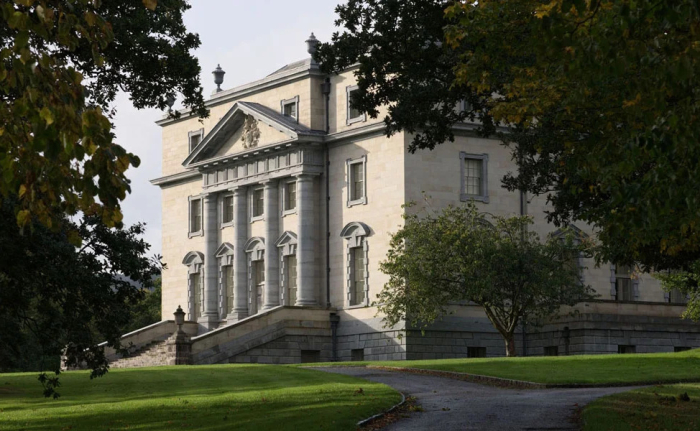
At places such as Clandon Park, the decision has sometimes been made not to reinstate everything to perfection, but to leave traces of what has happened.
It raises an uncomfortable question.
Do we restore something to look as though nothing ever occurred?
Or do we allow the building to show its scars?
In private residential work, we are often striving for immaculate results. But in nationally significant buildings, the narrative matters as much as the finish.
It made me reflect on how often we default to replacement when restraint might be more appropriate.
Can new craft become heritage?
Another idea that stayed with me was this: should exceptional craftsmanship in new houses be protected?
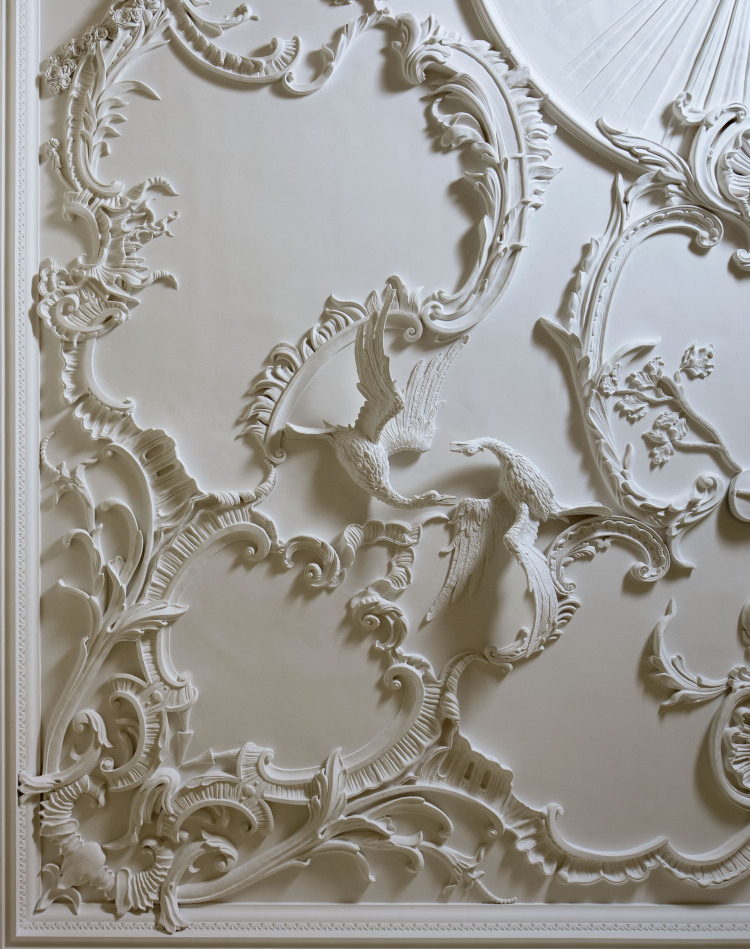
We see extraordinary plasterwork commissioned in contemporary country houses. Deep cornices. Carefully modelled enrichments. Classical proportions handled with real skill.
And yet those houses are young. Unlisted. Vulnerable to changing taste.
If the next owner dislikes ornament, it disappears.
There is something slightly tragic about that.
Good craftsmanship creates layers of meaning. Even in a newly built house, it begins to form the future history of that building. It gives it substance. Memory. Weight.
If we speak seriously about sustainability, surely cultural sustainability sits alongside environmental concerns.
What lies above the ceiling
We also talked about the damage done not by age, but by intervention.
Modern living requires services. Air conditioning. Lighting. Audio systems. Ventilation.
These are not indulgences; they make buildings usable.
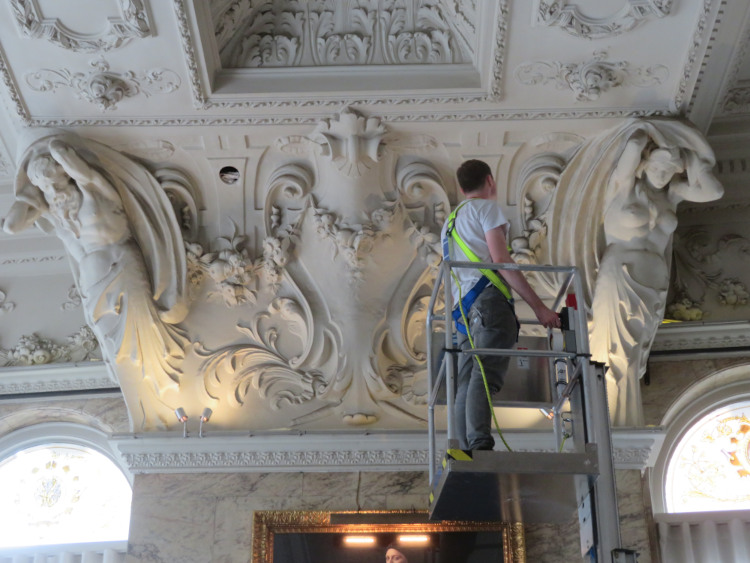
But we saw examples of original vaulted ceilings, long hidden above suspended ceilings, that had been cut through repeatedly over decades to accommodate wiring and ductwork.
In one Park Lane property, an extraordinary plaster ceiling had simply been hacked away by successive trades.
Often we do not know what we are cutting into. And sometimes we do not ask.
It was a reminder that investigation should always come before alteration.
The unintended harm of false ceilings
Suspended plasterboard ceilings are common in refurbishments. They feel harmless. Yet they alter how a building behaves.
When a void is created, moisture can become trapped. Air movement changes. Temperature fluctuations intensify. Above that new ceiling, original plaster can quietly deteriorate.
Thermal movement is particularly significant in large assembly spaces. The 2013 collapse at the Apollo Theatre was attributed to the failure of ageing fixings supporting ornamental plaster installed in 1901. Over eighty people were injured.
Historic plaster is resilient, but it depends on proper support and stable conditions.
Understanding how and why it fails is specialist work.
Supporting rather than forcing
One of the most fascinating practical demonstrations was how failing ceilings are supported during restoration. You cannot simply push them back into place.
Instead, acro props are used with soft rockwool cushioning so that the ceiling is gently held exactly where it sits. Penny washers may be introduced discreetly into joists to stabilise sections.
It requires judgement.
Too much pressure, and the plaster fractures. Too little, and it continues to sag.
This is not work for a general contractor experimenting on site. It demands a clear understanding of how historic plaster behaves, where it carries load, and how it fails.
Lime and the quiet virtue of breathability
We revisited lime plaster, and I was reminded why it remains such a remarkable material.
Lime plaster is:
- Breathable
- Flexible
- Able to move gently with a building
- Carbon absorbing as it cures
As it sets, lime reabsorbs carbon dioxide in a process called carbonation. It is slow, traditional and surprisingly sustainable.
Unlike modern plasterboard systems, it does not trap moisture within walls. It allows the building to breathe.
Historically, animal hair was added for tensile strength. There were rare instances in the nineteenth century of contaminated imported hair carrying anthrax spores — a curious historical footnote, and a reminder of how organic traditional construction once was.
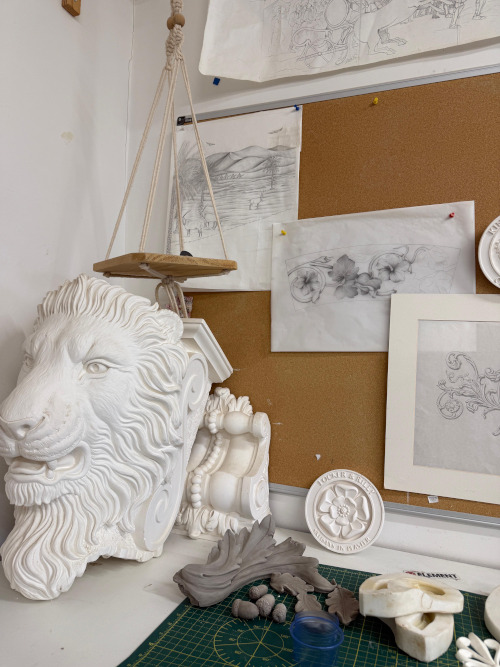
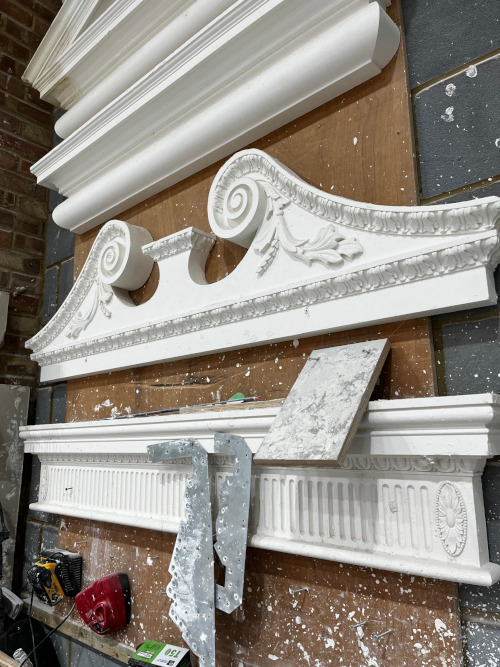
Images: Work in progress at the Locker & Riley Workshop
From lime to gypsum
Industrialisation brought fibrous plaster. Typically formed from gypsum reinforced with hessian, it could be cast off site and transported in sections. Production became faster and more consistent.
Gypsum is mined in the UK and across Europe, often in layers, with purer white seams particularly sought after.
Fibrous plaster is more brittle than lime, but its joints are stronger than the body of the material, which makes it effective in ceilings.
GRG — glass reinforced gypsum — is lighter still and allows for larger casts with fewer joins, useful for column casings and expansive ceiling sections.
There is always a balance between authenticity, practicality and performance.
Moulds, detail and continuity
The precision now possible in restoration is extraordinary.
Silicone rubber moulds have largely replaced traditional timber profiles. They are flexible enough to capture the finest detail — the veining of a leaf, the depth of a bead.
Where permitted, a section of original cornice can be removed and taken to the workshop, moulded and reproduced so that new work aligns seamlessly with old.If removal is not allowed, moulds can be taken in situ, though with greater complexity.
The aim is continuity, not replication for its own sake.
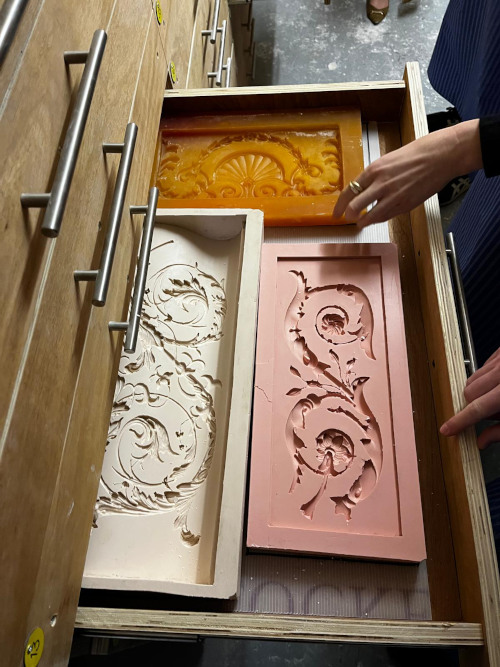
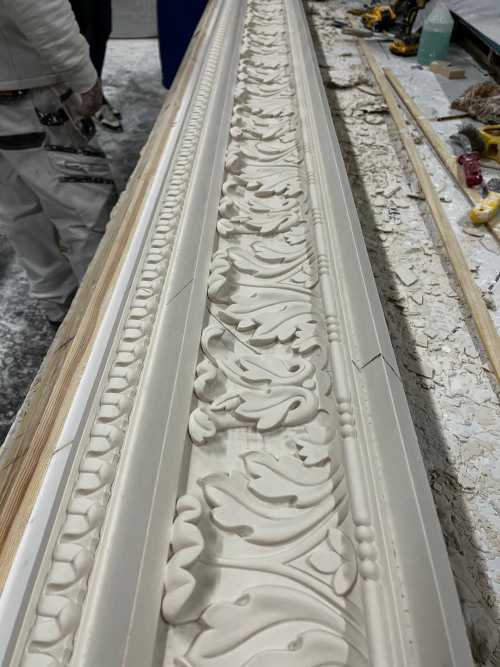
Images: Plaster mouldings & new cornice at the Locker & Riley Workshop
Removing centuries of paint
We also discussed paint removal. Over time, repeated redecorations can obscure the crispness of mouldings entirely.
A poultice may be applied to soften layers of paint, but timing is critical. Leave it too long and the plaster itself begins to erode. Too short, and the paint remains stubborn.
If a section can be removed to the workshop, steam stripping is gentler and more controlled.
It is a careful process. And it speaks to a broader principle: sometimes doing less achieves more.
Designing around modern comfort
Air conditioning and concealed lighting are now common requests in high-end homes.
The challenge is integrating them without compromising architectural language.
We saw examples of removable fluted friezes concealing vents, resin elements designed to allow future access, and detailing that accommodates maintenance without drawing attention to it.
Beauty must never prevent access. Nor should practicality undermine proportion.
In spa environments — something we are currently working on — plaster can perform well provided it is protected from standing water and raised on a tiled plinth.However, in areas of constant steam, such as directly above a hot tub, GRP (glass reinforced plastic) is often more appropriate. It can be finished to appear traditional while tolerating moisture far better.
Understanding material behaviour is not romantic; it is essential.
Looking to enduring examples
Locker & Riley’s work spans private houses and major heritage projects, including Kenwood House and the restoration of Buxton Crescent.
For anyone interested in proportion and detail, the Sir John Soane’s Museum remains one of the most inspiring places to visit. It reminds us that ornament, when handled intelligently, elevates rather than overwhelms.
These buildings endure not because they were fashionable, but because they were thoughtful.
What we took away
The day was not about ornament for its own sake. It was about:
- Investigating before intervening
- Understanding material behaviour
- Respecting what already exists
- Designing for longevity
As designers, we sit at the point where decisions are made. Whether a ceiling is explored or ignored. Whether lime is specified or plasterboard dropped in. Whether extraordinary craftsmanship is treated as disposable or valued as future heritage.
Quality rarely shouts. It simply lasts.
And perhaps that is the quiet lesson.
If we are serious about sustainability — environmental and cultural — then we must think beyond immediate convenience.
The most sustainable buildings are not those that look new.
They are those that remain worth keeping.
Main image credit: Locker & Riley : Private Residence